
They say, for farmers, the weather’s always bad.
Too much rain, too hot or way too cold.
But I, the miller, always got my share.
Farmers used to come to me with wagon-loads of wheat or rye.
I could feed my children, I could build my house.
The grinding stones were never still.
But then potatoes came and the people of the land craved less for bread.
Now my wheels have stopped. I close the door.
Decided.
It’s time for us to leave starvation.
Tickets in my hand, we are leaving for America.
I’ve heard they need a miller’s hand.
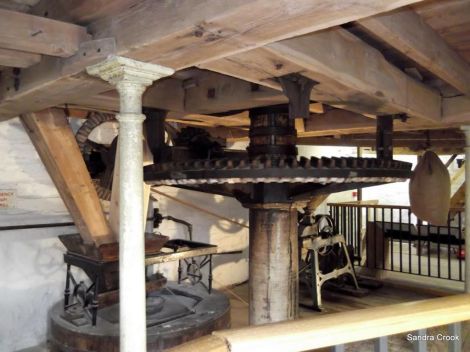
This is imagined from some historic background. In the end of the 18th century potatoes was introduced in Sweden, and it changed the rural life a lot. Potatoes required much less work, and fed the population better, so I imagined that among the first to suffer from this revolution where the millers. During the 19th century and early 20th century about 25% of Sweden’s population emigrated. If you find the subject fascinating I recommend you to read the Emigration series by Vilhelm Moberg.
The story has also been made into a musical (Kristina från Duvemåla).
Friday Fictioneers is a group of bloggers writing a 100 word story to the same picture under the guidance of Rochelle. Join this weekly fun, where I have been a happy participant for quite some time now.

—
January 4, 2016
 Björn Rudbergs writings
Wonderful tale of the dreams of a better future
Yes so many dreams, both those crushed and new ones rising from the ashes.
Aww, that makes me miss Brian.
So much in a name… so much from a miller’s hand.
I love discovering what small economic, cultural or climatic changes make a way of life and indeed a whole culture change. Great story, Bjorn
The potato had a huge impact on Sweden I was always told in school.
sounds like Ireland…
A lot like Ireland actually…
Dear Björn,
You taught me something I didn’t know. I’m a potato lover but I can’t imagine them replacing bread. Thanks for an informative story, well done.
Shalom,
Rochelle
I think there was still lot of bread, but definitely it shifted to potatoes.. much more food per area than grain.
I’m with Rochelle on this one, I didn’t realise there was competition between these two things. I love both so the miller is more than welcome to stay!
Great tale and nice to have the historical background. Well done.
Thank you… it might be some myth.. but we definitely became potato eaters in the 19th century.
i guess he has no choice when survival is at stake.
I see a parallel with migration happening today… if you are starving your options are limited.
Wow… a little snippet of history so not what I was expecting from Sweden… goes to show… we are never too old to learn!
At that time Sweden was one of the poorest countries in Europe…
I learned something new today, thank you. The miller was ranked with the blacksmith in importance.
Yes.. and indeed two of the most common last names too…
I never thought of the two foods as being in competition. Good one, Bjorn.
The changes were huge when you could get more food from the land (but I do not really know that millers got into problems…)
All change, but he’s taking action. Go where the work is!
Yes… that’s what has always happened… and what is happening now.
Really interesting snippet of history there – and I thought most mills went out of use because of industrialisation. Fascinating. I wonder if he was a success?
Yes that was probably a more important factor…
Love the historical background you used for this story!
Thank you.. it was fun to write.
And then came the potatoe blight, it drove some of my ancestors out of Ireland, to Liverpool and the rest is history as they say. I believe that the indigenous Irish where as poor as the people of Sweden
I think we were spared from that particular disaster… but there were many other reasons… small-pox vaccine had a big effect on people surviving too.
Like Maureen and Michael, I’m seeing the parallels with Ireland in your story. The earlier diet consisted of a lot of grain but that all changed with the introduction of potatoes, and then followed the disaster that was the Great Hunger.
I love how you captured the turning point, both culturally and for the miller himself.
I think the parallels are large… also in terms of the percentage of population leaving..
I like the tale and the way you tell it… and it does point to how major changes and migrations occur.
I think you have to feel that you are on your way to losing something. It’s not necessary the poorest that leaves… but those on their way down.
And it must take a certain foresight and courage.
And after that came Mr. Potato Head toys, finely ground out by a miller in America?
Honk. I’m sure I’m wrong.
Randy
Ha.. never thought of Mr Potato head.
A great tale, an interesting. You don’t really hear about millers. A big change for him and his family
Of course the millers became factory workers…
Great story Björn. And a really interesting take on the prompt.
Thank you Thom.. I tried to move into some imagined past. For sure potatoes must have changed a lot.
I love the historic take you took on the prompt. At first, I thought your story was about the Irish potato famine. Then this – the effect of potato farms on Sweden. Thanks for opening my eyes.
The change in Sweden and Ireland with potatoes was enormous… then the famine when things goes wrong… yes that happened here as well (but maybe not for the same reasons)
Don’t they say, “The cause of problems is solutions”?
Good take on the prompt. However, your third sentence is out of sync. You flipped into third person for the last part.
It should be But I, the miller, I always got my share.
Of course.. that makes much more sense… ha.
That’s for sure one reason so many left Ireland and came here to the Unites States of America to fulfill their dreams. Back then it was still possible. 😦
This made me smile. There’s a large Scandinavian farming settlement in North Dakota — and what are they growing? Potatoes. 🙂
Ha.. yes we are potato eaters here… when I was young we had boiled potatoes almost every day…
I’ve never thought about the impact potatoes had! You made it very real. I’m rooting for him.
I think he will do great, many farmers did…
Marvelous tale and the title is priceless!
Ha.. yes there are always those loosing out on change.
I love thinking about historical shifts in agriculture, industry, and economics and how they affected cultures, and you do such a great job of illustrating such a change through the eyes of a specific person whose life is changed. Interesting!
I think that when conditions are changing you see the movements… this is ongoing in the world right now.
I think it is always ongoing, somewhere, to someone. But yes, some years more than others.
Some of my ancestors came over the big puddle to flee starvation, but most of them were running from religious persecution.
Those were the main two reasons… the same as today I think
Interesting look at history. But what about new opportunities for Vodka makers 😉
Swedish Vodka was actually mostly potato based… so yes there were great ones… but also Swedes almost drank themselves to death in the 19th century.
Fascinating. I like it that your farmer was willing to take his skills elsewhere. I’m guessing that potatoes were nutritionally good for the poor as a source of Vitamin C as well as the B vits. Also, with flour, especially rye flour (not sure if this was the main crop at the time), it can have severe mold problems that can drive people insane. As for times of potato famine, were they able to recommission the mills and start producing more bread again, or were the mills past recommissioning?
Famine in Sweden (especially in the 1860:s) where not exclusive to potatoes but affected all crops alas.
So tragic. There must have been a huge death toll. People talk about the good old days, but not so when you look at things like this in history. …And they are still happening in some parts of the world.
Finally getting to catch up on reading, Björn–– so busy with getting to Israel and now being with my grandson and daughter! Wow, you’re right, we did write similar stories! My brain instantly went in this direction when I saw the photo. I guess it’s true: great minds do think alike. 😉
I hope all is well.. a long travel and I hope you are safe…
I am, Björn; thank you. Too close for comfort yesterday (I was in Jerusalem, in the Old City), but safe and sound.
An interesting story with the historical information. I couldn’t see potatoes and bread as an ‘either/or’ option, but can see how the growth of potatoes affected the miller.
With potatoes you can feed more people on less an area…
Damn the potatoes, full speed ahead. Oops, wrong projectile.
I read an interesting journal a few years back written by a young man in the early 1700s. His father not only ground grain with the grist mill but harnessed the water power to make other things, such as cut nails. This kept them busy year round. The miller needs to expand his offerings.
But that might put the blacksmith out of work… maybe they should have joined forces.
I really learned something here, Bjorn. The story was terrific, but the history was really something. We don’t know a whole lot about Sweden in America outside of Ingmar Bergman, Ingrid Bergman, some supermodels and, of course, the great meatballs and IKEA — actually, maybe we DO!
Anyway, it’s a very excellent story subject and is worth a few more. Great job, Bjorn!
Five out of five Swedish Fries.
If you come across a file called the Emigrants it tells a story of starvation in Sweden and then coming to Minnesota…. it’s a real classic made in 1971, and feature many famous actors, but was directed by Jan Troell not Ingmar Bergman.
Actually, I HAVE heard of that movie from back when I was in high school. One of our teachers said she saw it. I was too young to see it when it came out, I’m sure.
And, yes, I know there are more directors from Sweden than Ingmar Bergman out there, but when a product from Sweden makes that big a splash in the film world, what else can you remember, right? haha!
Thanks for this glimpse into history. Progress for some isn’t always progress for all! I’m not a farmer but as one who grows his own veg I can relate to the first paragraph 🙂
I think we all see today how work is disappearing
Fascinating stuff, wonderfully told. Thanks Bjorn!
Poor man – I hope he found work in America. I have a Norwegian friend who is researching her own family’s emigration to America – perhaps potatoes were part of the reason there too?
I think that potatoes was a reason more for a growing population both in Sweden and in Noway.
Maybe that’s why so many of us look like potatoes today!