
From Wikimedia Commons.
Signs of spring
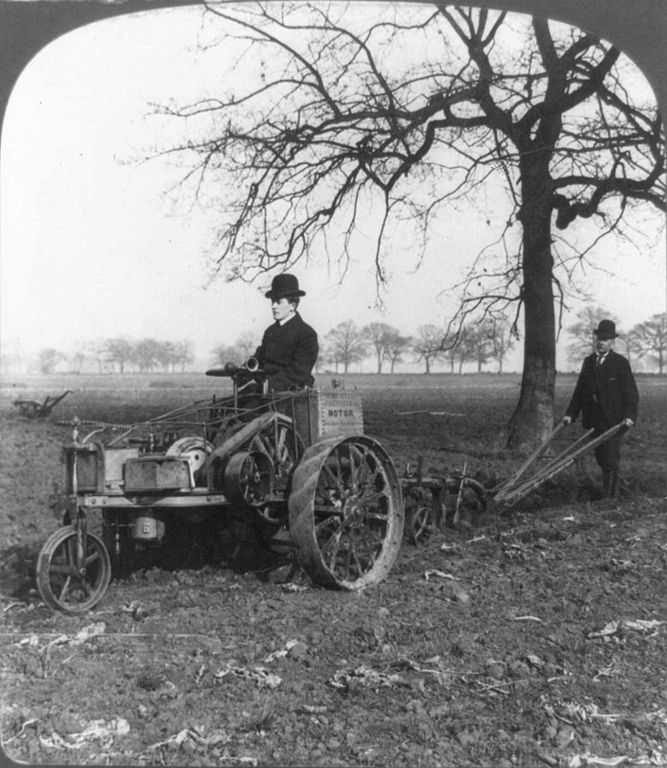
The tractor’s chewing spring-tired soil
preparing wishes of the seed
in this laidback equinox drizzle
I take a not yet decayed oakleaf
between my fingers
letting texture of its veins balance
dreams of earth-filled rebirth
and my winter’s sleep.
Slowly I crumble the paper-thin leaf-skin
with winter-clumsy fingers
watching wind-flakes swirling in the winds of sea.
And when salty perfume blends with soil
My sowed thoughts will grow.
This is a poem I interpreted from a poem I first wrote in Swedish. I find it interesting that my voice seems to change with this technique, and I wonder if this is a technique anyone else have tried to alter your poetic voice. To me both poems are still very much a work in process.
Here is my original Swedish Poem:
Ett vårtecken
Traktorn äter sig genom åkrarnas vårtrötta jord
beredande väg för såddens önskan
i vårdagjämningens lättjefulla duggregn.
Jag tar ett ännu inte förmultnat eklöv
mellan mina fingrar
känner de döda bladnervernas struktur balansera
drömmar av jordfylld återupfödelse
med vinterns sömn.
Långsamt smular jag den papperslika lövhuden
med valhänta vinterfingrar
och ser lövflingor singla i vinden från havet,
i en saltdoft som blandas med jord
kan min tankes sådd fås att spira.
March 10, 2015
 Björn Rudbergs writings
I like how this feels
I’m unable to understand different languages, but know when I attempt to write on a child’s level my poetic voice is different
Very interesting Bjorn! Somehow there will be elements of nearness between the two languages, I’m sure! But the ability to write in poetic lines for both languages is spectacular!
Hank
After reading the English version and then going to the Swedish, it is interesting I can pick out words with their meaning. I’ve a talent that way. But reading it in Swedish aloud and then reading the English aloud, the voice and tone does seem the same. That same sort of quiet awakening, I like this poem and to me, there is a dreamy feel although it is filled with action – plowing, crumbling, blending, awakening…This is the sort of poem, if it were in a book, is one I would seek out during certain times of the year to read. I applaud your incredible ability to write in English. I wish I could read Swedish rather than just pick out words, but again, I feel the same voice.
I think you are right.. the voice of Swedish poetry has always seemed a little slower, it often have a different beat, and it’s not that easy to translate to English.. I have written much less poetry in Swedish than English.. but I thought this would be an interesting technique in developing my poetic voice.
I like it. I printed them out to view side by side and to compare words. The flow and rhythm both have the same feelings. It is a great technique for developing your voice. That’s why I like the prompts at dVerse. many of the forms are almost like a different language because they get my brain going in a different pattern.
There seems to be something primal in these phrases; paper-thin leaf-skin, winter-clumsy fingers, wind-flakes swirling. Somehow they remind me of Beowulf, where the ocean is called the whale road.
I surprised myself by being able to pick out a few of the Swedish words, thought the pronunciation is beyond me.
Salty perfume is striking.
namaste
jzb
Ah.. you mean kennings .. which is those short metaphor.. we use them actually a lot as compound nouns are very common in Swedish, I wrote an article on kennings a year ago..
but usually my words here are less bold so to speak..
I am captivated by the contemplation of the oak leaf as the seasons turn. It would be wonderful if we could hear you read your poem in the original Swedish. Even if we could not understand it, the musical sound of language and inflection would be a treat.
I will see if I could add that 🙂 at least it would be Ok to do it with a Swedish accent.
The wishes of the seed dictate–I hope, I hope–because we do what we do with tractor and autumn leaf and it seems right. It seems we are signs of spring and so are the mental and physical things we sow.
We are all part of the sowing and planting. This was lovely.
You are very talented, learned and prolific!
A very evocative piece of prose. Your words are such that it became my hand holding and crumbling the leaf, my sensations of salty air. I did have the Google translator translate your Swedish part. That translation was slightly different with a few words not translated. An aside, my husband’s family Bible is Swedish from his maternal grandmother.
I love the concept of the ground being prepared for the wishes of the seed.
it is interesting that based on the language you wrote it in that it would change your voice…it is all part of the sowing and reaping…pretty cool second stanza…very visual and the symbolism of that releasing as well is strong…
I found it very interesting too.. I think this is something I will continue to experiment with..
What a great picture! Nice poem too!
Interesting–your voice is a bit different–I wrote a piece in Japanese a while back and translated it to English–the Japanese was better I think–but I felt oddly stifled in the translating–how did this feel for you??
I actually think my Swedish version was better… so I think I have two languages inside… but I will dig deeper into this technique
very cool. I wish that I could speak more than just English…I have heard that different languages actually affect the way that one thinks and reasons, for example some languages have more specific and/or descriptive words for something, while other languages have more general words.
Wonderful writing: “Slowly I crumble the paper-thin leaf-skin
with winter-clumsy fingers” – so evocative, on many levels.
I hardly write and think in my native tongue as my education was & is always English ~ I am in awe for poets who can write in two or more different languages ~
For your poem, I admire the word pairings & theme of rebirth for the new season ~
Loved the last line! “My sowed thoughts will grow.”
Alas! i can only read and understand the English version, which i think is really skillfully wrought
thanks for dropping in to read mine
much love…
“I take a not yet decayed oakleaf
between my fingers
letting texture of its veins balance
dreams of earth-filled rebirth
and my winter’s sleep.” Beautiful Bjorn! Here the soil is not yet ready to be tilled, still hidden beneath a foot or more of snow, but the birds are singing cheerfully!
Beautiful!!! and yes, I too have tried this technique, translated one of my poems in Hindi to English!
Ah, I’m enjoying spring weather but see old oak leaves still intact…so cool to be able to write poetry in more than one language!
Beautiful hope of spring..
Interesting to read the poem in two different languages. I have read poems before that people TRANSLATED…but they have always been translations of another poet’s work. I like the idea of the salty perfume blending with soil,then sown, and thoughts growing from there! I can’t speak for the Swedish version. Smiles.
The yearly cycle.of planting and reaping. Well done, Bjorn. 🙂 — Suzanne
I cannot read or write in another language, but I know beautiful words and thoughts. Your last two lines are stunning.
The English version I can only read is wonderful.:-)