
deeply rooted
branches sway in desert wind –
scorpion waits
Hamish Gunn has written a wonderful prompt, and he wants us to hide a deeper meaning in the haiku. Explaining my meaning forfeit the meaning of hidden meaning. I would love to hear if you find anything deeper in this haiku.
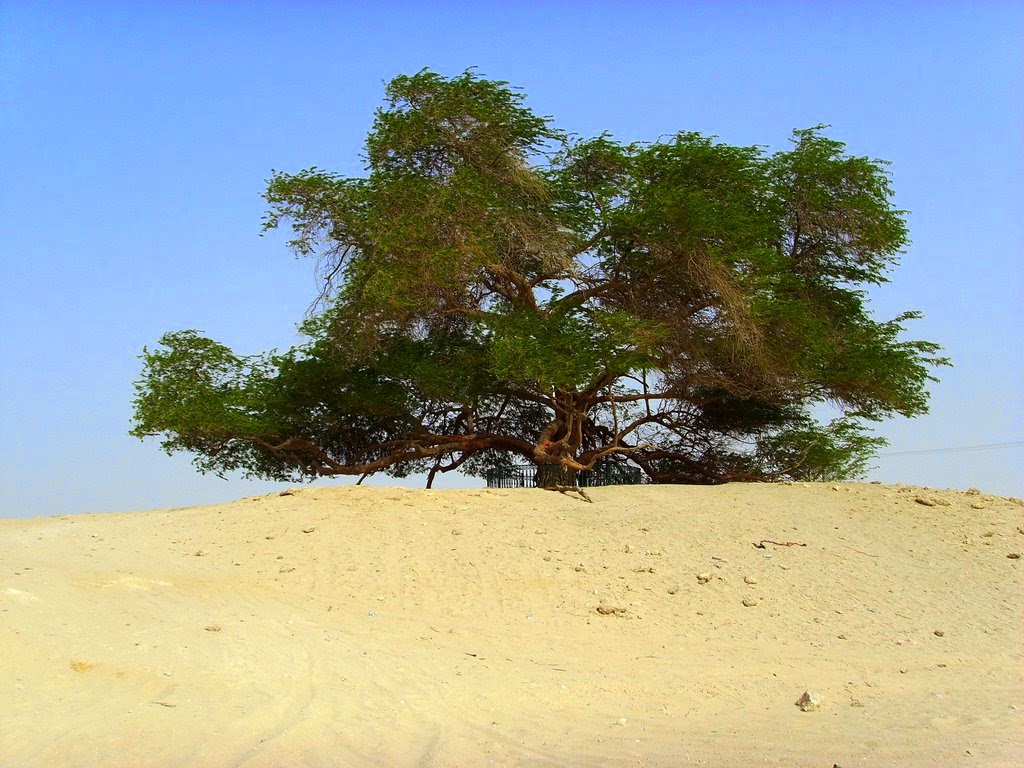
Tree of Life Bahrain (© Hamish Gunn)
Linked to Carpe Diem
—
2014-09-09
 Björn Rudbergs writings
we hunger for stabilitymaste
seek comfort from shade and breeze
but always there is danger
namaste
JzB
Let me try that again
we hunger for stability
seek comfort from shade and breeze
but always there is danger
namaste
JzB
Lovely…
grounded
stable against the wind
still, we’re vulnerable.
First, I am just going to enjoy its face value beauty. The strength of a tree facing yet another desert wind and somewhere near it? on it? a scorpion waiting. Waiting for what? A mate? it’s next meal? Doesn’t matter. The scorpion sets the scene further.
I could go on and force this beautiful setting to mean whatever I want it to mean like a tea leaf reader. I could try to guess what you mean, but I don’t like guessing games, I am not good at them.
I am okay if layers of association do not come to me right away or at all. I am okay with simply appreciating the strength of a living thing growing, nay, thriving in one of the seemingly most inhospitable landscapes on earth.
It’s beautiful, Bjorn.
Yes – this is how I do too.. Seeing layers is one thing, and I think once written a poem is created when it’s read, not when it’s written…
Wonderful haiku here — I may be reading it incorrectly, but it feels like being kicked out of Eden a second time — the danger in paradise.
I think the beauty is that it is whatever you want it to be…
Prof. Keating in Dead Poets’ Society: “When you read, don’t just consider what the author thinks, consider what you think.” 🙂
Much to think about — really enjoyed your response to the prompt.
The Fattail Scorpion typically inhabits desert and semi-arid environments throughout the Middle East, including the Arabian Peninsula, Egypt, Iran, Iraq, Israel and Turkey (countries with deeply rooted cultures and beliefs). The Fattail is one of the most dangerous scorpions in the world and can be a deadly predator, with a sting capable of injecting lethal venom.
Bjorn, I saw the deeply rooted tree first as an intractable person, for whom the sting of alternative thought awaits.
Also a deeply rooted person, a nature lover, whose arms sway in the breeze, knowing full well the scorpion (either real or figurative) is there, and not particularly caring! So there are my two opinions. Thanks, hon. Amy
Every word chosen so well in this wonderful haiku. Look at that last word, the scorpion’waits’ and doesn’t ‘sit’ for example. What a difference in tension! What does the scorpion know that we don’t? The wind brings beauty in movement, sound of rustling leaves, but also shakes the tree – and things fall, some towards where the scorpion waits good cooperates with evil, either intentionally or not, or the scorpion just waits because evil ‘does.’ If we compare – contrast this haiku to Basho’s frog, we see the frog as participant. It leaps, joins in with its environment. Here, the scorpion does not. In fact, an ant or other will be doing that leap or fall. So what is the role of the scorpion? We clearly see, and know the role of the tree, Biblically and from nature’s perspective. But should we just condemn the scorpion? That would be too easy. Is not its role similar to the wolf, that is so fundamental to nature’s balance?
An awesome Haiku with great depth! The essence of the Haiku is in the waiting scorpion.
Even strong bonds encounter challenges and pitfalls…that’s what I took away from this haiku.
Beware of the scorpions 🙂
This is a beauty … and the deeper layer is in the waiting of the scorpion … alert and ready to attack, if its having its prey … a life will taken. The tree stands strong and tall in the breeze, but if a strong storm (the scorpion) comes the tree will be de-rooted. In other words: a thought is just a thought, but if the thoughts are interchanged and disputed … thoughts can change … thoughts, deep hidden under the surface of our mind, waiting to be free and attacking … in my opinion this haiku gives in beautiful words and in a nice scene the idea of free-speech and free-speaking …
But … without that deeper thought … this haiku stays a beauty. Thank you for sharing Björn.
Bjorn, This could mean that as long as our roots are deep, we are able to withstand the storms of life. However, there are always threats to overcome. 🙂 —Susan
Very brilliant meaningful Haiku poetry ! Love this exquisite tree and the way it forced you to spread it’s magic through your words.