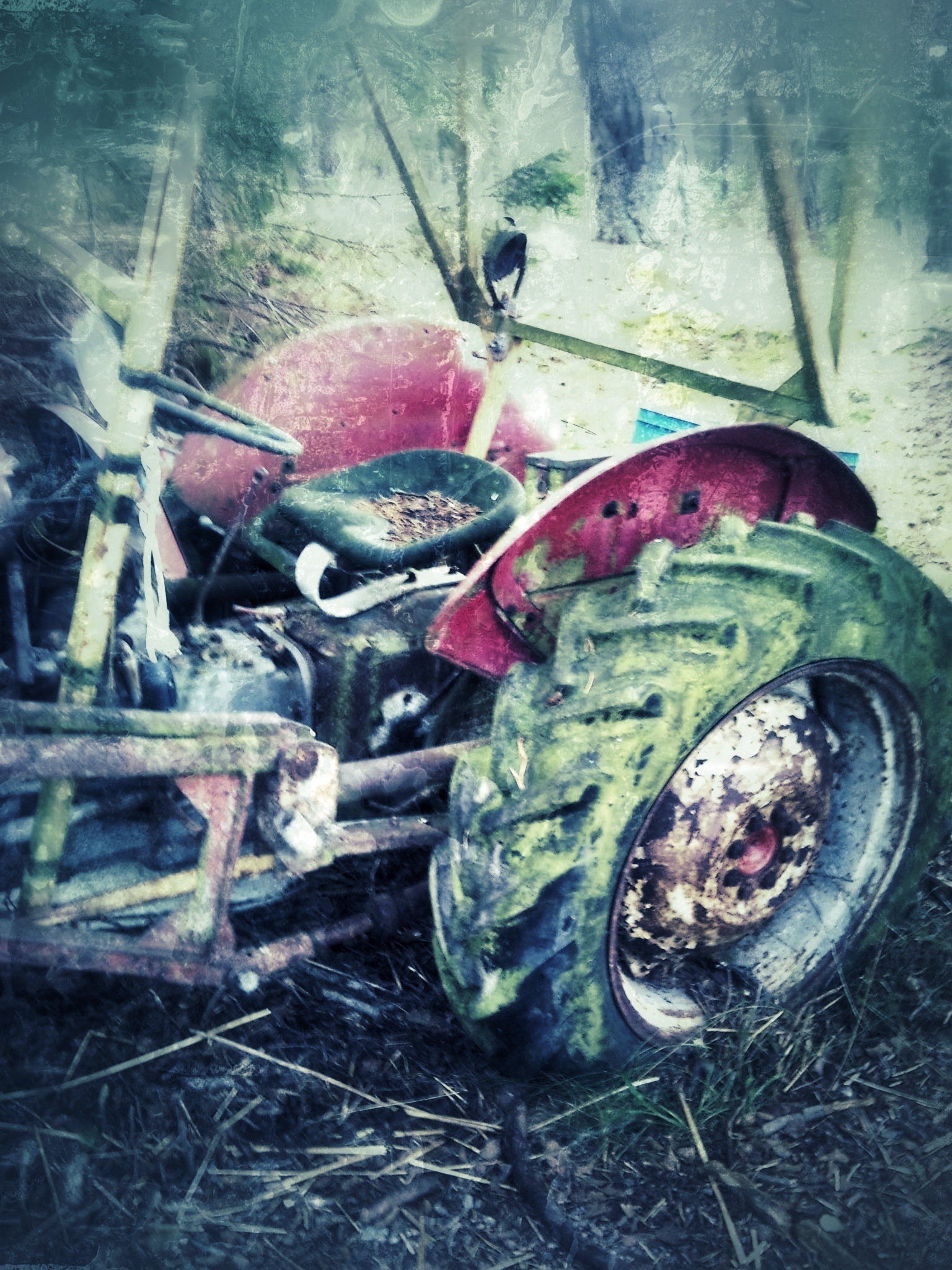
The old discarded servant’s come to rest
Beside the outhouse, waiting for the rust
A blanket from the woods, of moss, is blessed
Against the chilly mornings, his disgust
~~
He still recalls, arriving with applause
So shining red, he sparkled in the sun
The owner proudest in the village was
His strength and vigor anyone could stun
~~
He did his duties faithfully each day
A master’s friend in sunshine and in hail
But lost his strength, and then one day so gray
He failed to start, and had from work to bail
~~
So then, replaced, he was with new machine
And towed away to graveyard, here so green
—-
A little sonnet for a retired tractor.
2012-08-30
Björn Rudbergs writings
Poetry and fiction by a physicist from the dark side

 Björn Rudbergs writings
very nice, truly enjoyed
Thank you John. It was a sad old tractor.
I am very sentimental about such things. I have aways wondered why I should be so reluctant to part with a favored old item. It was so from when I was very young. I have learned to overcome it, however, I remember well the old feeling, not so covered up by age and experience. Of sadness, betrayal, loss, loneliness. It was as though the objects themselves had souls, I thought much later on in adulthood.
Now, even much, much later, I have come to think that, closer to the truth is this: That in these objects we invest part of our own soul, and feel the loss as the object is ripped from it–away from us, that part of our soul remaining, yet feeling the effect of the beloved object torn from us–ripped away. So we feel the loss as though the object were an old friend.
I was not sure what to think about this piece at first, because it changes mood swiftly, and more than once–sometimes seeming deadly serious, and sometimes whimsical. I think I wanted–because of these feelings of loss that are natural to me–It to be serious, or whimsical in its entirety. However… one doesn’t always get what one wants, and this, too, is a lesson which should be refreshed from time to time.
I believe I am starting to recognize your unique voice as it resonates within your poetry, such that I might recognize a poem to be yours, or at least reminiscent of one of yours, when encountering it randomly.
David, first of all thank you for reading through my entries. I love your feedback.
On the difficulties in parting with an object I think you are 100 percent correct. If it has seen daily use it become a part of you, and it doesn’t matter if it’s a tractor or a teapot.
On the poem I think you are right. I changed my own mood while writing it, at first I almost wanted to do something “comical”, but the sadness of the old machine grew on me just like it would have done if I had grown up with “him”.
You are most welcome. Reading your work provides much needed relaxation between writing and other work.
Very nice, Sir. I especially like this:
“A blanket from the woods, of moss, is blessed
Against the chilly mornings,…”
I like the thought of the old tractor snug under his blanket of moss. Once again your imagery sparks my imagination.
I am very glad that both you and David wrote about this. I find I have the same reaction – specifically, to tools. Their use gives them a hold over me and some of them retain such echoes that I give them an honored place in my environment. Hence, my carefully polished harp with the broken soundboard catching the light by the window, the cracked bread-bowl atop the kitchen cupboards, David’s first pipe – long after he stopped smoking – in the bookcase. I hadn’t thought of the fact that I decorate with beloved old tools until this very moment. I cherish them.
Once again, I am sent over here by David to read something he knows I will delight in and I find a treasure. Thank you, Sir.
ld tracc
Thank you, and I agree, tools become an extension of you, and become impossible to part with.
Pingback: Beloved Objects: | David Emeron: Reflections upon Reflections·
Pingback: Beloved Objects: | David Emeron: Sonnet Blog·
Pingback: Beloved Objects: | David Emeron: Sonnets·