
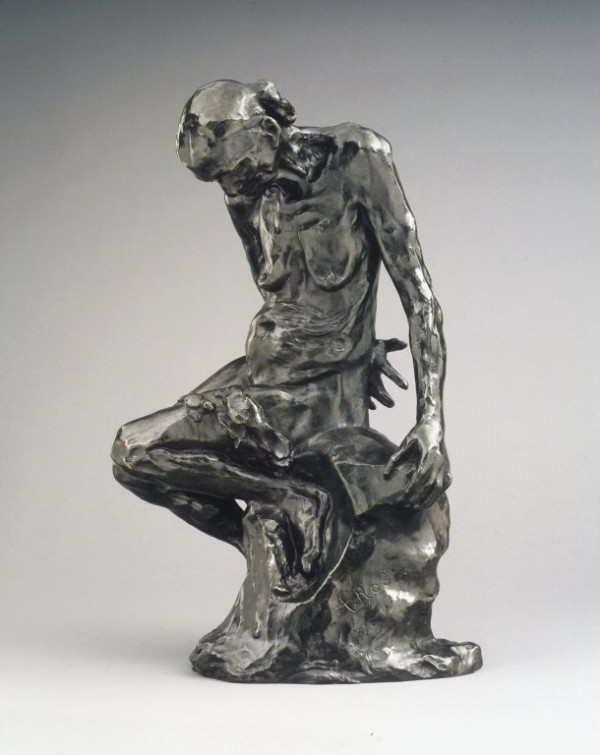
Rodin: The old courtesan
I wish I was a better man
I wish I could rid myself of prejudice
share a cup of coffee – listen
to her story of abuse
that’s written in her veins
I wish I could travel deep
into her eyes and see
a pony-tailed hopscotching
giggling little girl her mother left
and tell her that I care
I wish I was a better man
I wish I could relieve her of the dread
that leaded weight of age
I wish I was a better man
instead I listen to my fear
and leave
—
Today at dVerse MTB we have a guest writer for MTB. Bill Webb, who encourage us to take this citation by Rilke to our heart. Write about something that goes to our heart and that feels important.
“write about what your everyday life offers you; describe your sorrows and desires, the thoughts that pass through your mind and your belief in some kind of beauty Describe all these with heartfelt, silent, humble sincerity and, when you express yourself, use the Things around you, the images from your dreams, and the objects that you remember.”
Rilke was very much influenced by Auguste Rodin, and we can also use a sculpture of him as influence. I have thought a lot about the poem I wrote for dVerse poetics.. and actually my true reaction to meet a prostitute. To some extent I’m a coward just running away, and I wanted to express the kind of man I want to be.
Amazingly this poem also fit Kerry’s prompt on dichotomy at real toads, so I link up late there also.
—
September 4, 2014
 Björn Rudbergs writings
Amazing how difficult it can be to overcome our fears and become the people we want to become/know we should become.
in the bottom lies fear I think..
Wow – you really stepped up and set the bar high on this one Bjorn. Some failures make us grow as men and women.
if you are aware of them–
Bjorn, Sadly, some people are bejond our help. We can only pray that somewhere, somehow, they get the help they need. We need to always remember that there but for the grace of God, any of us could go. 🙂 —Susan
And alas, we rely too much on god to solve problems that humans should solve themselves.
Being ‘human’ is difficult after all. Love your poem.
Thank you.. and it’s more important than ever.
it is easier…to leave
because when we take on someone else’s baggage
a bit of it becomes our own…i think it is a failure
we have all faced at some point
Leaving will create another type of burden.
I can understand your frustration. We all have people (or categories of people) who make us uncomfortable, no matter how hard we try to overcome the feeling.
I think it’s a human failure.. still something I rather not have.
I appreciate the honest appraisal Bjorn ~ Facing or leaving, we are always burdened with our decision ~
Yes.. a burden either way.
My feeling is I don’t think a person should beat themselves up for what they cannot do, but to concentrate on what they can do. And I am sure there are many.
there are things one could do I think..
empathy makes us see deeper than what’s on the outside… it’s not always easy to know how to talk to someone then or how to meet them… i wish i was braver as well
yes.. I’m a coward in cases like this..
Facing our fears can be one of the hardest things, when our body just wants to walk (or run away). Beautiful depiction of this here.
Indeed the fear of facing anything like this is hard.
This is amazing – both what is written and unwritten. I’ve had encounters with troubled people and it’s complex. Yes, I (we) want to reach out a helping hand, but sometimes the weight gets too heavy, like we’re barely treading water without a life vest. Walking away is the immediate easy solution, but then the burden of guilt about what we didn’t do eventually creeps up on us…
Indeed.. that’s exactly the point here.. It was great to take Rilke and Rodin as a starting point for a poem..
The danger in remaining, in interacting, in reaching out are the memories of every time we have done that, & then being mugged, victimized, taken advantage of, scammed; a harsh fact of life. We are given enough burdens to bear within the sphere of our own realities, but as a poet, you see her with different eyes for a vulnerable moment.
We’ll never know what the real danger is.. I left before finding out.
Yes fear is usually behind everything that doesn’t serve us. I really like your sad poem. So often we are afraid to communicate our love, our caring and we leave the situation.
Fear is the curse of mankind..
that’s one real challenge….to do or not to do…a good one..
Thank you.. those moments are tough
it’s not easy; everyone has taken the easy way out at some point and time…
but the price of the easy way is high too.
Ah yes, the all encompassing fear! It has a way of taking over! Fear is our strongest weed in life.
I feel the push-pull here Bjorn. You wrote this brilliantly and it captures the emotions elicited by the sculpture brilliantly. I might add a grammar note (please don’t take offense), but in English in cases contrary to fact we use the subjunctive.rather than the indicative case. This from Wikipedia might make more sense (I know it’s weird for Texans to get too…I guess that’s why it’s ingrained in my mind.) Anyway it ought to be “if I were” not “if I was”.
“The English subjunctive—that is, the subjunctive mood in English grammar—is an irrealis mood used to form verbs in statements that do not describe known, objective facts. These include statements about one’s state of mind, such as opinion, belief, purpose, intention, or desire. The subjunctive mood is also used for statements that are contrary to fact, such as, “If I were a giraffe,” … (subjunctive), as distinguished from, I am a human being. Subjunctive statements often occur in dependent clauses, such as the subjunctive example in the preceding sentence. In contrast, the indicative mood is the English language’s realis mood used for unqualified statements of fact, such as, I speak English.
“In Modern English the subjunctive form of a verb is in many cases the same as a corresponding indicative form, and thus subjunctives are not a very visible grammatical feature of English. For most verbs, the only distinct subjunctive form is found in the third-person singular of the present tense, where the subjunctive lacks the -s ending: It is necessary that he see a doctor (contrasted with the indicative he sees). However, the verb be has not only a distinct present subjunctive (be, as in I suggest that he be removed) but also a past subjunctive were (as in If he were rich, …).”
Not to interrupt, but this is POETRY! The laws that govern the land just cannot apply! Unfortunately, English comes from the ‘street,’ or battlefield, or trade wind. There is no academy that decides what is true or real, and both Oxford and Webster dictionaries add words gleaned from life yearly, unlike languages like, say, Russian, French or Hungarian which mandate language form in both lexical and grammatical form. We cannot substitute their academies which decide what language is acceptable with ‘Wikipedia’ in English! We should look at successful communication rather than accurate communication.
Bjorn and Hamish. I felt a little awkward leaving that note. Just if I were writing I would like some one to let me know that little bit of grammar – then I could choose to use it or not as I chose. If English were Bjorn’s first language, indeed I would not have left the note at all. I am very sorry for having posted it and really know I should have done so privately. Again I apologize.
Oh dear – my intention was definitely not to cause anyone to feel apologetic – more that the topic was interesting, and one that I had strong long-term opinions about – but only that, opinions only, and about the topic you raised. I smiled at your 2nd line!
Thanks. No problem. I wrestled with myself over it. But I so admire Bjorn and his skills and dedicated my poem today to him as he is well skilled at language. I thought it would be ok to write it, and then wanted to pull back. Thanks for your note. It makes me feel less awkward. Thanks Hamish.
It’s perfectly ok to point out error.. If i do errors I want to do them intentionally – and I should have known 😉 – and yes languages change – so does Swedish..
I appreciate this a lot Gay, and my error was not the intended one.. and of course I should have known..
The echoed line here gives the piece such a “stayed awake all,night thinking about this” feeling, Björn. Haunting.
Deep! very deep….
Your words echo cross the entire planet for people to listen and awake.
Beautiful!
That world of ‘I wish’ can hang like a massive cloud over everything we do. (And by the way, that subjunctive use is for formal speech. The simple, flawed, informal speech of your speaker does not require it–just my 2 cents.)
Well..i’ve definitely been here before and done it..and experienced these feelings too..and a person who worked with people many years and then worked with computers moving away from people..i felt my abilities weakening in the basic human ability to be strong enough to burden the pain of others..to be their for others..
All i can say..is i know at least for me..change is possible but yes it is so hard..when problem solving is a way of life..rather than human connection that does require practice..practice..practice too…
Poetry and efforts like this can spark the light of empathy growing brighter and mostly why i write…
To be a human being..as i lives as human robot..most definitely before.
Wonderful Bjorn! I have walked away from people a few times in my life, their stories almost suffocating. Now I wonder if I could have helped them in some way instead of running out of fear?
What a powerful write, Bjorn. Bravo for writing on this topic. It can make us uncomfortable to see a damaged soul, think of how they started off perfect and innocent, and it is normal to feel helpless and turn away. The cool thing is, you care. I love this poem!
Raw and intense – a very personal moment gently unfolded and surmised.
you wrapped this up with a lifetime of emotions… to never say, “I wish I would have…”
What an awesome contrast to the other version! This one really moved me.
In such a short poem – you said a lot – yes, those feelings resonate with me too….
fear is the most difficult thing to overcome..time and again it comes back and haunts..well said
I was going to write that this is an amazing poem, and it is, but there’s so much more to be said and this probably isn’t the place, space, time, to go into everything it’s made me feel. Maybe that’s it, Björn, it makes me feel…and it is so in tune with the image – nice one – love it.
Ah, yes. This does present the dichotomy: Between the idea and the reality, between the motion and the act… falls the shadow.
Hiya Bjorn – love “the leaded weight of age…” and the delicately truthful melancholy in your close…
This says so much about who we really are, how it interacts with who others are, despite what we wish–still, I think that wish to be better, more understanding, does reach through the communication to the other, and it does make a difference if genuine. No one else can actually heal us, but being listened to, feeling sympathy and concern, is a very effective balm. Enjoyed and appreciated this piece, Bjorn.
to be a better man means making mistakes, reflecting on them, and if within your power adjusting the next time you are faced with a similar situation. without mistakes there is nothing to be better than. hmm…that sounds a bit confusing…sorry…
an enjoyable read.
Your honesty is refreshing and the topic you bring to light is important on many layers. Thank you, Bjorn.
Bjorn, I empathize very much with this sentiment. Sometimes I can be stronger and reach out, but being shy by nature usually takes over. I really admire people who can reach out to anyone. Beautiful, heartfelt poem, exactly what Rilke inspired 🙂
This gave me shivers, I’m not sure why. I have been in this situation, there were times i stayed & tried and times I walked away and wondered why.